
 |
|
|
|
|
|
 |


 |
Suspension Problems! |
 |

|
 |

|
(#1)
|
|
RC-Monster Carbon Fiber
Offline
Posts: 87
Join Date: Oct 2008
Location: Central California
|
Suspension Problems! -
11.01.2008, 06:30 PM
Hello, I put some new shocks on (These to be exact) and the rear suspension just droops. There is no rebound or support when the wheels are on the ground at all. I am also using 30 wt shock oil. Is there any way to fill the shocks correctly to solve the issue, or do I have to step up the oil weight? Thank you for any ideas.
|
 |

|
 |
 |
 |
|
|
|
|
|
|
(#2)
|
|
RC-Monster Dual Brushless
Offline
Posts: 5,061
Join Date: Oct 2007
Location: Thousand Oaks CA
|
11.01.2008, 06:45 PM
Try like 60wt oil.
|
  |
|
|
|
|
|
|
|
|
|
|
(#3)
|
|
HOOH HUAH HOOH! Aww Baby!

Offline
Posts: 868
Join Date: Oct 2007
Location: olyWA
|
11.01.2008, 07:29 PM
Use higher weight, more preload. Also try firmer springs.
|
|
|
|
|
|
|
|
|
|
|
|
|
(#4)
|
|
RC-Monster Aluminum
Offline
Posts: 812
Join Date: Mar 2008
Location: bay area california
|
11.01.2008, 07:41 PM
yes, try firmer springs
|
|
|
|
|
|
|
|
|
|
|
|
|
(#5)
|
|
RC-Monster Carbon Fiber
Offline
Posts: 87
Join Date: Oct 2008
Location: Central California
|
11.01.2008, 08:05 PM
Cool, I like those ideas, but how would they affect off-road performance? I only bash off-road and I love to try crazy jumps. I have a feeling that high weight shock oil and jumps don't go together, but I'd love to be wrong if a higher shock oil is the fix.
|
|
|
|
|
|
|
|
|
|
|
|
|
(#6)
|
|
RC-Monster Dual Brushless
Offline
Posts: 5,061
Join Date: Oct 2007
Location: Thousand Oaks CA
|
11.01.2008, 08:44 PM
Heavier weight shock oil for jumps is the way to go. Springs are what you wouldn't want for jumping.
|
|
|
|
|
|
|
|
|
|
|
|
|
(#7)
|
|
|
HOOH HUAH HOOH! Aww Baby!
Offline
Posts: 868
Join Date: Oct 2007
Location: olyWA
|
11.01.2008, 09:28 PM
Quote:
|
|
|
|
|

|
|
|
|
|
|
|
|
|
(#8)
|
|
RC-Monster Dual Brushless
Offline
Posts: 5,061
Join Date: Oct 2007
Location: Thousand Oaks CA
|
11.01.2008, 10:45 PM
Fyp?
|
|
|
|
|
|
|
|
|
|
|
|
|
(#9)
|
|
|
RC-Monster Carbon Fiber
Offline
Posts: 87
Join Date: Oct 2008
Location: Central California
|
11.01.2008, 10:49 PM
Quote:
 I never would have thought that. How does it affect overall off-road handling? (Not just the jumps, but doing all kinds of stuff off-road) I never would have thought that. How does it affect overall off-road handling? (Not just the jumps, but doing all kinds of stuff off-road)
|
|
|
|
|
|
|
|
|
|
|
|
|
|
(#10)
|
|
Soldermaster Extraordinaire

Offline
Posts: 4,529
Join Date: Apr 2007
Location: Plymouth, MA, USA
|
11.01.2008, 11:19 PM
Softer springs allow better suspension travel for climbing over objects, while harder springs keep you from smacking the ground when landing every jump. I would say springs which are just hard enough to hold the truck at your desired ride height (on level ground, fully loaded) coupled with a higher weight oil (50-80 weight) would give you the best overall performance.
|
|
|
|
|
|
|
|
|
|
|
|
|
(#11)
|
|
|
HOOH HUAH HOOH! Aww Baby!
Offline
Posts: 868
Join Date: Oct 2007
Location: olyWA
|
11.02.2008, 05:54 AM
Quote:
I think you should do more research on what shock oil does and the effect it has with different viscosity. There's a reason you use higher shock oil for larger jumps. |
|
|
|
|
|
|
|
|
|
|
|
|
|
(#12)
|
|
RC-Monster Carbon Fiber
Offline
Posts: 225
Join Date: Sep 2008
Location: Suomi Finland Perkele
|
11.02.2008, 01:25 PM
i just fixed my suspension issue, just by changing to thicker oil and adding preload. now running losi front 50 rear 45, it might need thicker oil, so that 60wt is what you should try, and adding preload so that you get right ride height.
|
|
|
|
|
|
|
|
|
|
|
|
|
(#13)
|
|
|
RC-Monster Carbon Fiber
Offline
Posts: 87
Join Date: Oct 2008
Location: Central California
|
11.02.2008, 04:31 PM
Quote:
And you are right gtxracer, I know nothing about shocks and how they work, do you know of any good pages I could look at for information? Thank you. |
|
|
|
|
|
|
|
|
|
|
|
|
|
(#14)
|
|
HOOH HUAH HOOH! Aww Baby!
Offline
Posts: 868
Join Date: Oct 2007
Location: olyWA
|
11.02.2008, 05:58 PM
RC shocks work very similar to 1:1 vehicle shocks. There's a piston inside the shock body; in RC they're plastic with holes in them to allow fluid to pass. Different pistons provide different dampening. The bigger the hole, the more fluid can pass through it. Usually, with large jumps you want a medium to big hole with high weight fluid so it dampens the blow, AKA, the landing. Smaller holes and high weight fluid can cause your shock shafts to bend, your shock towers to break, or your shock mounts to break.
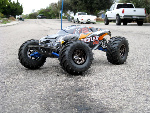
With large tires like the Mashers in your avatar photo and high jumps you'll want higher weight, like the 60wt you chose already. Springs help with rebound and smaller jumps as well as keeping the vehicle level. They also control how your supension moves when you're cornering. Loading up your truck with just stiff springs for jumping will hinder your performance greatly. Preload spacers and threaded shock bodies help keep the vehicle up and allow easy ride height adjustment so you can have softer springs yet keep your truck higher in the air while maintaining optimum performance. I plan to jump my CRT and I have the big bore shock kit. I'll be loading it up with 50-60wt to start with since the shocks are so big. Then I'll go higher or lower if I need it. You can tell if you need more or less with how the vehicle responds when it lands. Say you're jumping 30 feet lengthwise and about 15 feet in the air each time. You want to watch your truck and try to land near perfectly. If your chassis smacks the ground, you need thicker (higher weight) fluid. If you land and your truck bounces or hardly has any suspension movement, you need thinner (lower weight) fluid. Hope this all makes sense. Keeping your shocks and suspension tuned will help you keep your truck in one piece. 
|
|
|
|
|
|
|
|
|
|
|
|
|
(#15)
|
|
RC-Monster Carbon Fiber
Offline
Posts: 87
Join Date: Oct 2008
Location: Central California
|
11.02.2008, 11:28 PM
Awesome, I will use this to decide my setup. Thank you very much.
Also, how does a higher weight oil, such as 60 wt, affect the off-road performance, such as going over bumpy terrain or cornering? |
|
|
|
|
|
|
 |
«
Previous Thread
|
Next Thread
»
| Currently Active Users Viewing This Thread: 1 (0 members and 1 guests) | |
 Linear Mode

|
|

Powered by vBulletin® Version 3.8.11
Copyright ©2000 - 2025, vBulletin Solutions Inc.
vBulletin Skin developed by: vBStyles.com
Copyright ©2000 - 2025, vBulletin Solutions Inc.
vBulletin Skin developed by: vBStyles.com
