
 |
|
|
|
 |


 |
 |

|
 |

|
(#31)
|
|
RC-Monster Carbon Fiber
Offline
Posts: 126
Join Date: Mar 2009
Location: Ohio
|
06.25.2009, 11:19 PM
Hey pd ever think of making an esc out of fets like
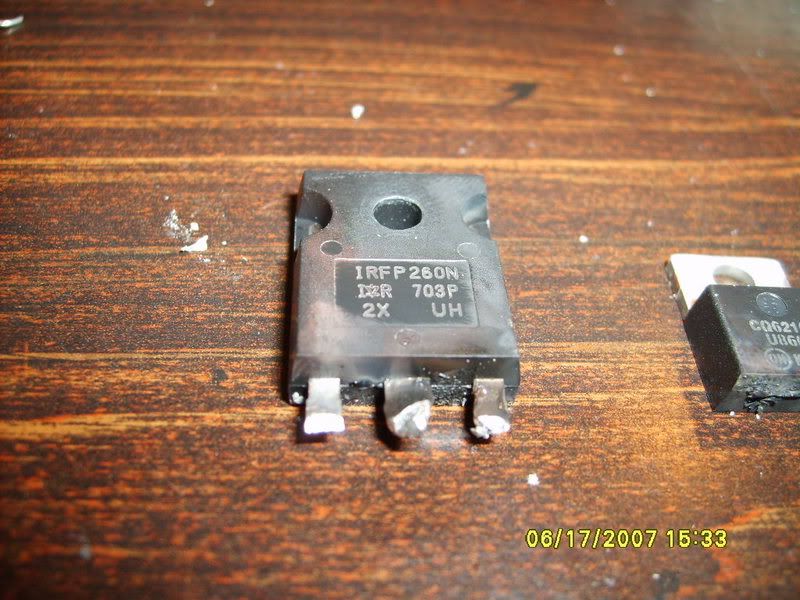 sure this ones dead but what do you expect when a EMI kickback of 3kv and 20a shorted arcross while switching a direct feed from a wall out let, but anyways I mean these things would make a mamba system next to industructable, with ratings of 340v @ 100A. sure this ones dead but what do you expect when a EMI kickback of 3kv and 20a shorted arcross while switching a direct feed from a wall out let, but anyways I mean these things would make a mamba system next to industructable, with ratings of 340v @ 100A.
Futaba 3pk more controller then anyone person needs TC5 top speed drifter 21mph on crappacks and 40 on calc |
|
|

|
 |
 |
 |
|
|
|
|
|
|
(#32)
|
|
|
RC-Monster Dual Brushless
Offline
Posts: 5,061
Join Date: Oct 2007
Location: Thousand Oaks CA
|
06.26.2009, 12:43 AM
Quote:
Cool machine Patrick. Hope it works well for ya. Nice price too! I'll give ya a canada flag button and a WOW 2008 foam finger for it! |
|
   |
|

|
|
|
|
|
|
|
|
|
(#33)
|
|
i pwn nitro

Offline
Posts: 769
Join Date: Nov 2008
Location: with ur GF
|
06.26.2009, 04:05 AM
did the castle gang have a part ass machine prior to this perdy new one?
must be able to make some the company's output a lot more efficient  now...since it's an electric machine...MAMBAFY IT!!!!  1,000,000 parts per second FTW!!
the porthole from the noob world an here has been opened!! that's how i got in. |
|
|
|
|
|
|
|
|
|
|
|
|
(#34)
|
|
|
RC-Monster Titanium

Offline
Posts: 1,697
Join Date: Mar 2008
|
06.26.2009, 11:02 AM
Quote:
That is a 200V, 46A (rated) FET you have pictured there, with a resistance of 55 milliohms. (in practical terms, this FET can handle about 10 amps with a large heat sink -- about 5.5 watts of waste heat.) The FET we are using in the Mamba Monster is a 30V, 191A (rated) MOSFET, with a resistance of 2 milliohms. (in practical terms, this FET can handle about 25 amps with a minimal heat sink -- about 1.25 watts of waste heat) We are using 36 mosfets (6 per phase-half) in the Monster, so the actual resistance is about .33 milliohms. Using 36 of those IRFP260s in the same configuration would yield a resistance of 9 milliohms, and would need a shoebox sized controller... seriously. At 150A, the Mamba Monster dissipates about 15 watts of heat from the FETs. At 150A, the IRFP260s would need to dissipate 405 watts of heat. Ready for a 25 pound heat sink bigger than your truck?? And, it wouldn't be indestructible -- quite the opposite. The dies would run at VERY high temperature (due to junction to heat sink thermal resistance,) and the controller would have a short life. It would, however, run at much higher voltages. So, you would need to run, say, 40S lipos (electrocution danger?) at low current (10 amps or so...) In practical terms, the best configuration for an ESC today is lots of large-die, small package MOSFETs in parallel. The package we are using (SO-leadless) handles a huge die, but is packed into a small package. This allows us to place lots of parallel MOSFETs into a very small area, and maximize efficiency. Large die, large package MOSFETs like the one you have pictured would require us to use fewer MOSFETs per controller, and would have significantly higher resistance -- thus higher losses, larger heavier heatsinks, and lower efficiency. In the long run, this means higher cost, heavier controllers, and less power to weight ratio. What we try to do in ESC design is minimize waste heat generated in the controller -- heat is the enemy of controllers. Heat losses are equal to (current squared) times the resistance of the MOSFET (this is known as "I squared R losses", often written as I^2R.) So in designing an ESC, we try to minimize R to the lowest possible level, while still making an affordable ESC. President, Principle Engineer Castle Creations |
|
|
|
|
|
|
|
|
|
|
|
|
|
(#35)
|
|
RC-Monster Titanium
Offline
Posts: 1,697
Join Date: Mar 2008
|
06.26.2009, 11:58 AM
No video yet of our new machine running (I have to figure out how to get a camera into a position where you can see something actually happening...)
But here is a video of an AC-30L running, which is the same as our OLD machine. The AC-30L (which we traded-in on our new machine) is a single head rotary drive machine with 30 spindles. Our new machine is a four head, 120 spindle machine, and is about 20% faster per head due to the linear drive. Remember when watching this that our new machine runs like this one, but has FOUR heads working at the same time. http://www.youtube.com/watch?v=oEz4L...eature=related And here is another video of a Genesis (linear drive) single head machine running: http://www.youtube.com/watch?v=Wd-DU...eature=related President, Principle Engineer Castle Creations |
|
|
|
|
|
|
|
|
|
|
|
|
(#36)
|
|
RC-Monster Admin

Offline
Posts: 14,609
Join Date: Nov 2005
Location: Des Moines, IA
|
06.26.2009, 12:01 PM
Sweet! It looks like a plotter, but in 3d.
 I definitely have to come down there sometime for a tour! Let us know when everything is up and running. |
|
|
|
|
|
|
|
|
|
|
|
|
(#37)
|
|
|
RC-Monster Titanium
Offline
Posts: 1,697
Join Date: Mar 2008
|
06.26.2009, 12:08 PM
Quote:
Yeah, it does look like a plotter -- the difference being that the pick and place head and gantry weighs in at about 400 lbs, and accelerates at 9Gs...  The whole machine weighs in at a little more than 4 tons... President, Principle Engineer Castle Creations |
|
|
|
|
|
|
|
|
|
|
|
|
|
(#38)
|
|
RC-Monster Admin
Offline
Posts: 14,609
Join Date: Nov 2005
Location: Des Moines, IA
|
06.26.2009, 12:10 PM
OK then, a weighty, speedy, precise, very costly, and really heavy-duty plotter.
|
|
|
|
|
|
|
|
|
|
|
|
|
(#39)
|
|
|
RC-Monster Titanium
Offline
Posts: 1,697
Join Date: Mar 2008
|
06.26.2009, 12:17 PM
Quote:
 The frame has to be really stiff, so that the accuracy doesn't suffer (any flex in the frame would cause placement inaccuracy,) and really heavy so that the machine doesn't "walk" while building. Oh, and BTW, we are up and running at full capacity now. President, Principle Engineer Castle Creations |
|
|
|
|
|
|
|
|
|
|
|
|
|
(#40)
|
|
|
RC-Monster Aluminum

Offline
Posts: 764
Join Date: Apr 2008
Location: canada, quebec
|
06.26.2009, 12:18 PM
Quote:

|
|
|
|
|
|
|
|
|
|
|
|
|
|
(#41)
|
|
|
Soldermaster Extraordinaire

Offline
Posts: 4,529
Join Date: Apr 2007
Location: Plymouth, MA, USA
|
06.26.2009, 12:19 PM
Quote:

|
|
|
|
|
|
|
|
|
|
|
|
|
|
(#42)
|
|
RC-Monster Admin
Offline
Posts: 14,609
Join Date: Nov 2005
Location: Des Moines, IA
|
06.26.2009, 12:24 PM
Post edited. Happy now? I even added "costly".
|
|
|
|
|
|
|
|
|
|
|
|
|
(#43)
|
|
|
RC-Monster Aluminum
Offline
Posts: 764
Join Date: Apr 2008
Location: canada, quebec
|
06.26.2009, 12:28 PM
Quote:
 i cant imagine how fast is in full capacity and 20%faster i cant imagine how fast is in full capacity and 20%faster my god this machine is ...i dont find the word...dam fast< so i should take less (very less)time to produce the new mm pro....!!!or a ton of mmm |
|
|
|
|
|
|
|
|
|
|
|
|
|
(#44)
|
|
|
Soldermaster Extraordinaire
Offline
Posts: 4,529
Join Date: Apr 2007
Location: Plymouth, MA, USA
|
06.26.2009, 12:31 PM
Quote:
|
|
|
|
|
|
|
|
|
|
|
|
|
|
(#45)
|
|
Something, anything, nothing

Offline
Posts: 2,747
Join Date: Mar 2006
Location: Houston, TX
|
06.26.2009, 12:33 PM
Patrick, does this machine require an isolated concrete pad to be placed on? That was a big issue with our lasers, we had to have isolated pads to eliminate unwanted vibration that could throw a head off track. As you know, even .00001" can be a big deal.
|
|
|
|
|
|
|
 |
«
Previous Thread
|
Next Thread
»
| Currently Active Users Viewing This Thread: 1 (0 members and 1 guests) | |
| Thread Tools | |
| Display Modes | Rate This Thread |


 Linear Mode

|
|

Powered by vBulletin® Version 3.8.11
Copyright ©2000 - 2026, vBulletin Solutions Inc.
vBulletin Skin developed by: vBStyles.com
Copyright ©2000 - 2026, vBulletin Solutions Inc.
vBulletin Skin developed by: vBStyles.com
