
 |
|
|
|
 |


|
|
 |
 |

|
 |

|
(#1)
|
|
RC-Monster Admin

Offline
Posts: 14,609
Join Date: Nov 2005
Location: Des Moines, IA
|
11.19.2006, 12:15 AM
This thread seems a bit confusing. I agree with GD for the most part. Assuming the motor impedance is constant and the load is constant, an increase in voltage will increase current.
A motor is not a "constant power" device, so you can't say a motor is going to put out, say, 1800 watts no matter what voltage is applied. This is painfully obvious from the runtime achieved. If a motor always pulled 1800 watts, batteries would last a VERY short time. For a given voltage, it will draw the current it needs to do the job. The product of the voltage and the current creates the power. Finding amperage by dividing a constant wattage by the applied voltage is not correct, sorry. However, motor RPM and inductance does have a factor in this though. Higher rpms can increase the back EMF, which is comparable to increasing the resistance, which decreases current. So, the "resistance" is not linear like in a pure resistor. So, an increase in voltage will increase rpms, which will increase the back EMF, which increases impedance somewhat, and decrease resistance, but not as much as the conversation here seems to imply. Example, a 10v, a motor draws 10A. This is 100W. This equates to a 1 ohm "resistance". However, at 20v, the same motor with the same load may draw "only" 18A. This is 360W. The impedance increased to 1.1ohms. A pure resistor would have stayed at 1 ohm, which would have developed 20A (and 400W). The rpms, and the increased back EMF they created, made the resistance go up a little. But it certainly did not go up enough to generate the same 100W. |
  |

|
 |
 |
 |
|
|
|
|
|
|
(#2)
|
|
|
RC-Monster Mod

Offline
Posts: 6,254
Join Date: May 2005
Location: Baton Rouge
|
11.19.2006, 01:40 AM
Quote:
|
|
 |
|
|
|
|
|
|
|
|
|
|
(#3)
|
|
RC-Monster Admin
Offline
Posts: 14,609
Join Date: Nov 2005
Location: Des Moines, IA
|
11.19.2006, 01:43 AM
Sorry. :dft001: :)
|
|
|
|
|
|
|
|
|
|
|
|
|
(#4)
|
|
TEAM FUSION

Offline
Posts: 2,041
Join Date: Jul 2006
Location: Iowa... Hawkeye country
|
11.19.2006, 10:05 AM
[QUOTE=BrianG]This thread seems a bit confusing. I agree with GD for the most part.QUOTE]
That's because I'm right, BrianG :005: Look at it this way.... run your car with a watt meter/data recorder in it... on whatever battery you normally run in it. Now add one more cell to it and run it again. Amps (and watts) go up, not down. That's just the facts, it's the way things work. This is not meant to be confused with using higher voltage to be able to run lower gearing and/or lower kv motors to get greater efficiency. I think some are not focusing on the original question about the motor specs. 10v at 100A= 1000W 20v at 50A= 1000W 100v at 10A= 1000W This is true, obviously.... but you can't apply it backwards to our cars and say that a given motor will put out a constant 1000W, therefore, if you run it on more volts, the amps will go down. Again load (gearing) has a big effect on the amp draw, and it's possible that a setup geared for the same top speed may indeed draw less amps on 5s than on 4s with the same performance. I'm sure this is what everyone is thinking of if they disagree with what I have posted. But that's not the point in question. |
|
|
|
|
|
|
|
|
|
|
|
|
(#5)
|
|
|
I like chocolate milk
Offline
Posts: 650
Join Date: Dec 2005
Location: Houston, TX
|
11.19.2006, 11:38 AM
Quote:
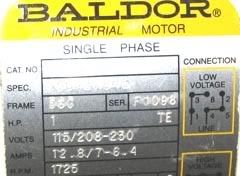 As much as has been argued otherwise, a motor is a constant power device, and the proof is right there in the picture. As voltage goes up, amp draw goes down. If it didn't, then if you ran this motor on 208v, it would magically become a 3.5 HP motor, which is not possible. When you run it on 208v, it draws less power. It's not able to do any more work (which means horsepower, which is equivalent to 746 watts) than it was on 110v, which is exactly why the amp draw goes down. The motor power is set by the design, not the voltage. Either I'm wrong, or someone changed the laws of Thermodynamics while I was sleeping. Sleebus |
|
|
|
|
|
|
|
|
|
|
|
|
|
(#6)
|
||
|
RC-Monster Aluminum
Offline
Posts: 748
Join Date: Oct 2005
|
11.19.2006, 12:19 PM
Quote:
Quote:
Artur P.S. It is very simple "how it works" Cool link and more models on the side bar |
||
|
|
|
|
|
|
|
|
|
|
|
|
(#7)
|
|
|
RC-Monster Admin
Offline
Posts: 14,609
Join Date: Nov 2005
Location: Des Moines, IA
|
11.19.2006, 01:33 PM
Quote:
Motors are not constant power. The power listed on a motor tag will be at the nominal rated voltage. Actually, they usually list this power as "VA" which takes power factor (basically an efficiency factor) into consideration, but I won't go into that. If you double the voltage, you WILL increase current and power by a substantial amount. Maybe not exactly double because of the change in rpm (therefore beack EMF, ie: resistance), but close. Most dual voltage (120v/240v) AC motors I've seen have alternate sets of windings/connections for the optional voltage; or if three phase, you can hook the windings in wye instead of delta or vice versa. And that's what the little diagram on the right looks like - a way to wire the windings for higher voltage. The motor windings would not like it if you tried to double the current going through them. So, the alternate wiring was designed to increase resistance enough so the power remains the same with higher voltage. Besides, how could a passive device be constant power? The resistance would have to change. The only way for a device to be a constant power device is if it had active circuitry to read the voltage and be able to adjust its resistance to develop less current to generate equal power. Ohms law is Ohms law, and it works - always. It gets a little more complicated than simple Ohm's law for AC motors because you have to take in drive frequency, rpm, and winding inductance (which changes the voltage to current phase angle). |
|
|
|
|
|
|
|
 |
«
Previous Thread
|
Next Thread
»
| Currently Active Users Viewing This Thread: 1 (0 members and 1 guests) | |
| Thread Tools | |
| Display Modes | Rate This Thread |


 Hybrid Mode
|
|

Powered by vBulletin® Version 3.8.11
Copyright ©2000 - 2026, vBulletin Solutions Inc.
vBulletin Skin developed by: vBStyles.com
Copyright ©2000 - 2026, vBulletin Solutions Inc.
vBulletin Skin developed by: vBStyles.com
