
 |
|
|
|
 |


|
|
 |
 |

|
 |

|
(#1)
|
|
RC-Monster Brushless
Offline
Posts: 2,085
Join Date: Sep 2007
|
01.06.2010, 09:16 AM
Hi Brian,
Is this project still on hold? Last night, I put together an identical setup. Using a MM Pro, an Eagletree, and a Servo Tester. For a load, I rewired a Ceramic Heater so the heating element was fired from the MM Pro. The heater fan was left wired to regular house current. Well, the ceramic heater core does not work as a load. It's total resistence is too low it appears. I couldn't get much of an amp load to register at all. What other choices for a load are there? How about an electro magnet? Any ideas on how big it would have to be or the Ga. wire it would require? Just a thought, as larger versions are rather power hungry. |
|
|

|
 |
 |
 |
|
|
|
|
|
|
(#2)
|
|
RC-Monster Admin

Offline
Posts: 14,609
Join Date: Nov 2005
Location: Des Moines, IA
|
01.06.2010, 11:04 AM
Actually, this project is probably permanently on hold. I don't think it will have enough use to justify its cost to assemble - at least for what I originally planned. Who knows, I may revisit this later on, but let's just say it's not on my immediate "to-do" list.
That doesn't surprise me really. A 1500w heating element running on 120v means the core has a resistance of 9.6 ohms. A 4s battery will only draw 1.54A with that resistance. You could go with some dummy loads. Depending on how much current you want to draw, you have to arrange a bunch in parallel and make sure the power rating for each one can handle the heat. And the power dissipated will obviously change depending on what voltage you are testing. If you are looking to only test ~10A on 2s, that's easy enough since the power is only ~75w. Eight 4 ohm 20w resistors in parallel to get a 0.5 ohm load will get you there, and then you use the ESC to regulate that amount. Don't forget, the ESC will only reduce the current (via voltage switching) to any given load, so make up a resistor bank that will have the lowest resistance you will ever want to test. Wiring again depends on test current. For ~10A, 12-16GA is adequate. As you go up, gauge has to go up as well. This test system becomes rather complex as you start getting into the higher test currents. If you want to draw 100A @ 2s, you really need to make sure the resistors can handle the heat, there is minimal wire/contact resistance, and shedding the heat can become a problem. If you want, I still have a bunch of 3 ohm 50w resistors that I'm not using. I got over 200 of them via ebay, but it was cheaper buying this many even though I won't need near that amount rather than getting the exact amount I needed. Their 50w rating is only good if properly heatsinked. Some CPU heatsinks can work if there is a fan blowing on the fins. |
  |
|
|
|
|
|
|
|
|
|
|
(#3)
|
|
|
RC-Monster Brushless
Offline
Posts: 2,085
Join Date: Sep 2007
|
01.06.2010, 06:36 PM
Quote:
Perfect this setup, then step up to bigger if needed. I appreciate your input Brian. Thanks. 
|
|
|
|
|

|
|
|

|
|
|
|
|
|
(#5)
|
|
|
RC-Monster Brushless
Offline
Posts: 2,085
Join Date: Sep 2007
|
01.06.2010, 06:28 PM
Quote:
Hmmm...........Thanks for the suggestion. I would like to construct a unit that would do the job in a small package though. |
|
|
|
|
|
|
|
|
|
|
|
|
|
(#6)
|
|
RC-Monster Admin
Offline
Posts: 14,609
Join Date: Nov 2005
Location: Des Moines, IA
|
01.06.2010, 06:32 PM
Small and high power don't go well together. You need surface area to shed the heat produced and a fan to circulate the air. So, you want around 1500w eh?
|
|
|
|
|
|
|
|
|
|
|
|
|
(#7)
|
|
RC-Monster Admin
Offline
Posts: 14,609
Join Date: Nov 2005
Location: Des Moines, IA
|
01.06.2010, 06:52 PM
Woah! 2500w?? You trying to heat your house?
 Seriously, you are gonna have a heck of a time trying to shed that kind of heat! Be prepared for a large setup and plenty of airflow. And I would do this kind of testing somewhere where an exploding lipo won't do any harm, because at those current levels, bad things can happen. Seriously, you are gonna have a heck of a time trying to shed that kind of heat! Be prepared for a large setup and plenty of airflow. And I would do this kind of testing somewhere where an exploding lipo won't do any harm, because at those current levels, bad things can happen.When I was in the design stage, I decided to stick to lower cell counts, up to 3s max, to keep heat down. Also keep in mind that if you design it for 100A @ 6s, then hooking a 3s pack will only draw 50A. Likewise, if a 3s pack will draw 100A on your load, then running 6s on that same load will draw 200A. So, you might need some way to create load "modules" so you can adjust the resistance as needed based on the cell count under test. 100A @ 6s will require a ~0.2 ohm load. At that current level, wire and contact resistance can make a big difference. If your wire/connectors introduce say, 0.05 ohms of resistance, that calculated 100A draw will be more like ~80A because of the added resistance. One of the roadblocks I had was coming up with an accurate way to draw a specific current. Since I was testing to confirm battery discharge ratings, I wanted to be able to draw an exact figure. But since battery voltage will fluctuate over the course of the cycle and the amount of load placed on them, I would have to keep adjusting the ESC output to make sure the current stays constant. Easy enough if testing constant discharge, but when testing bursts, the fluctuating voltage will make it darn near impossible to manually adjust it. This would need a form of feedback to tweak the ESC as needed. It just got too complicated to be called "home brew". My point is: if you are doing this for your own benefit, then this issue is no big deal as long as you are "close enough" to satisfy you. |
|
|
|
|
|
|
|
|
|
|
|
|
(#8)
|
|
|
RC-Monster Brushless
Offline
Posts: 2,085
Join Date: Sep 2007
|
01.06.2010, 07:03 PM
Quote:
A hit list of pwm settings for different voltage levels should give a ball park figure of where to start. On the issue of maintaining a constant amp draw: Sounds like a "home brew" controller is in order for that to happen. Perhaps a separate current measuring circuit that would automatically adjust pwm input to the ESC. That's gonna take some "doing". LOL One hurdle at a time though. First goal is to make it work. Then we'll iron the kinks out. |
|
|
|
|
|
|
|
|
|
|
|
|
|
(#9)
|
|
|
RC-Monster Admin
Offline
Posts: 14,609
Join Date: Nov 2005
Location: Des Moines, IA
|
01.06.2010, 07:12 PM
Quote:
When you start testing bursts, it gets a little tricky. You know that the PWM signal for an ESC is 1ms (rev/brake) - 1.5ms (neutral) - 2ms (wot). So, you already only have 0.5ms to play with when going from neutral to wot (rev/brake is not used). If you "cap" the ESC throttle at say 50%, you then only have 0.25ms to play with. Now, you are really reducing the resolution of the signal so when trying to make tweaking adjustments, you may not have enough resolution to adjust the output exactly where you want. The use of an aircraft ESC may help with this since it doesn't have reverse and so it has the full 1ms of throttle range to work with. Personally, it would be easier to make load modules so that each one is X ohms, and you just parallel what you need to get into the ballpark. I hope that made sense. |
|
|
|
|
|
|
|
|
|
|
|
|
|
(#10)
|
|
|
RC-Monster Brushless
Offline
Posts: 2,085
Join Date: Sep 2007
|
01.06.2010, 07:24 PM
Quote:
Sounds the resolution on such a pwm controller will have to be very precise. I see your point. I think the initial goal will be to measure and graph a constant amp load. You're looking at imitating the current demands of a Monster Truck, aren't you? I've noticed with the Eagletree results, average current draw is really very low, But those spikes! My but those spikes are many times more than the average current draw. I would like be able to adjust the amp draw to a preset level. Just like some Lipo manufacturers do. Here's how the voltage per cell that's held under a 20 amp draw, a 50 amp draw and 100 amp draw for the life of the discharge cycle. Then, here's how many mah's were used during the discharge cycle. In noting differences in how Lipo cells are rated, it's not only the "C" rating number they love to "toy" with, but it's also the actual mah capacity of the cell. Both the "C" rating and the Mah rating, drastically affect the performance of the cell. One thing about the Eagletree, it's really easy to hook up a temp sensor for ambient, then another temp sensor for pack temperature. All good information to record when it comes to testing. We need a good system to use as a "measuring stick", then we can let the tests roll!
|
|
|
|
|
|
|
|
|
|
|
|
|
|
(#11)
|
|
RC-Monster Brushless
Offline
Posts: 2,085
Join Date: Sep 2007
|
01.08.2010, 12:38 AM
OK, I've been searching high and low for the ideal DC Load for this, and it hit me.
A large Electrolysis Cell. One that breaks the moleculiar bond on the Hydrogen and Oxygen Atoms that form Water. I remember about a year ago when the Hydroxy Craze was at it's peak, I built and experimented with a 4S2P Plate Arrangement. The thing was REALLY amp hungry too. It was being regulated at around 10 amps on 12 volts, but it would be no problem at all to push it on up. Amp draw regulation was controlled by how much Sodium Hydroxide was added to the water. Sodium Hydroxide (Lye) was added to increase the conductivity of the water thus increasing Hydrogen and Oxygen production. The Amp Draw increased with the conductivity of the water. So we have a "Load". I know what you're thinking, but there is a safe way to do this. Good construction of the cell itself, along with a secondary bubbler that vents to the outside, plus a spark arrestor for safety's sake. To "Force" a cell like this creates alot of heat. So much in fact, it will boil the water if continued long enough. The test window would be short enough to avoid this. Afterall, how long will a 5000mah lipo last at 100 amp continuous drain? 5 minutes? Thoughts Brian? |
|
|
|
|
|
|
|
|
|
|
|
|
(#12)
|
|
RC-Monster Admin
Offline
Posts: 14,609
Join Date: Nov 2005
Location: Des Moines, IA
|
01.08.2010, 01:26 AM
lol, sounds like it should work. A little complex for me, so I think I'll stick to plain old resistors.
 And a 5ah pack will theoretically run 3 minutes at 100A. Of course, usable capacity will be less at that kind of continuous draw, so figure ~2.5 minutes. |
|
|
|
|
|
|
|
|
|
|
|
|
(#13)
|
|
RC-Monster Spudgunner
Offline
Posts: 2,353
Join Date: Apr 2008
Location: South Dakota
|
01.08.2010, 10:42 AM
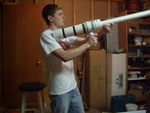
Here's an idea, from doctorbass,
|
 |
|
|
|
|
|
|
|
|
|
|
(#14)
|
|
|
RC-Monster Brushless
Offline
Posts: 2,085
Join Date: Sep 2007
|
01.09.2010, 03:30 AM
Quote:
|
|
|
|
|
|
|
|
|
|
|
|
|
|
(#15)
|
|
RC-Monster Brushless
Offline
Posts: 2,085
Join Date: Sep 2007
|
01.09.2010, 03:32 AM
OK, on with other Load options.
Here's a rather interesting inexpensive idea. http://www.neon-john.com/EV/Battery_...ester_home.htm It's a 500amp load tester that uses a carbon pile for resistence. I would think this could be modified with additional heat sinking to handle the load. Afterall, 12 volts at 500 amps is 6000 watts.
|
|
|
|
|
|
|
 |
«
Previous Thread
|
Next Thread
»
| Currently Active Users Viewing This Thread: 1 (0 members and 1 guests) | |
| Thread Tools | |
| Display Modes | Rate This Thread |


 Hybrid Mode
|
|

Powered by vBulletin® Version 3.8.11
Copyright ©2000 - 2025, vBulletin Solutions Inc.
vBulletin Skin developed by: vBStyles.com
Copyright ©2000 - 2025, vBulletin Solutions Inc.
vBulletin Skin developed by: vBStyles.com
